RA C will integrate contributions from RA A and RA B, while at the same time providing results to the other parts of the TRR 408 AgiMo. RA C will take up the new behavioral data and models from RA A, and the methods for analyzing, simulating, planning and managing transportation systems and mobility services from RA B. Projects in RA C will combine and enhance these outcomes from RA A and RA B into the AgiMo Digital Twin, which will provide up-to-date network-wide assimilated mobility data.. The AgiMo Digital Twin will then be directly applied to compute the decarbonization scenarios for responsible mobility. Participatory methods for scenario planning will be developed in collaboration and iterative feedback loops with the development of the Digital Twin. The potential of Large Language Models (LLM) for enhancing simulation-based methods for mobility planning will be explored in C6. RA C will also feed into RA A and RA B by providing metrics for transportation system appraisal and network-wide assimilated mobility data.
C
C1
New metrics for transportation system appraisal
Project C1 aims to support the transition to responsible mobility by developing novel methodologies that assist in the evaluation of transport policies through specific aspects of the 4F principles: Function, Form, Fairness, and Forever. To create a user-centric fairness-oriented evaluation framework, perspectives from diverse social and political justice theories are integrated to address uneven impacts on differing population groups, aiming for a fair distribution of transportation costs and benefits. To achieve this practically, we use automated transportation modeling to set up test-case experiments for network design optimization. By applying data analytics, multi-objective optimization algorithms, and objective reduction techniques including index fund and hybrid portfolio methods, we aim to identify Pareto optimal conditions that facilitate the mathematical balancing of competing personal and public needs thereby enabling more equitable transportation network development.
PI: Prof. Travis Waller Team members: Ankit Basu
C1
C2
Scenarios for responsible mobility and livable cities
Project C2 will advance scenario techniques methodologically and theoretically by incorporating quantitative and qualitative data, improving spatial representation methods, and testing different participatory workshop formats and digital tools. The exemplary scenario process combines Exploratory Scenario Planning (XSP) and backcasting approaches in systematic feedback loops with the emerging AgiMo digital twin. Main project outcomes thus include the novel participatory scenario process for integrated transportation and urban planning, the tested and evaluated digital tools, and their application for developing and evaluating the decarbonization scenarios.
PI: Prof. Vanessa Carlow Team members: Olaf Mumm, José Manuel Piña Contreras
C2
C3
Integration of data and models towards the AgiMo Digital Twin
C3 will use results from many other projects of this CRC, especially open data models from C4, integrate those into the MATSim framework and, on this basis, develop the AgiMo digital twin in cooperation with INF. The starting point will be a simulation of a region in combination with a setup that updates that simulation regularly, initially once per week, using a mobilephone based datafeed. We will leverage a data feed previously utilized in the context of COVID-19-related simulations to adopt activity participation levels. The core AgiMo digital twin will be directly applied in C4 to generate decarbonization scenarios in close collaboration with C2.
PI: Prof. Kai Nagel Team members: Dr. Michael Zilske, Daniel Röder
C3
C4
Simulation-based development of coherent scenarios for decarbonized transportation systems and responsible mobility
Project C4 will build and provide open data models for C3. It will be the simulation-based companion project to C2. C4 will apply the assimilated models from C3 to develop coherent decarbonization scenarios and to support C2. On the one hand, C4 will take proposals from the participatory process, implement them into the technical simulation and feed back the results to C2. On the other hand, C4 will come up with alternative proposals to feed them into the discussion process in C2. Similarly to C2, C4 will develop backcasting scenarios and assess them based on the 4F principles developed in C1. C4 will further work on improvement of the demand and supply calibration.
PI: Prof. Kai Nagel Team members: Simon Meinhardt, Gregor Rybczak, Daniel Röder
C4
C5
Novel assessment methods based on the multimodal macroscopic fundamental diagram
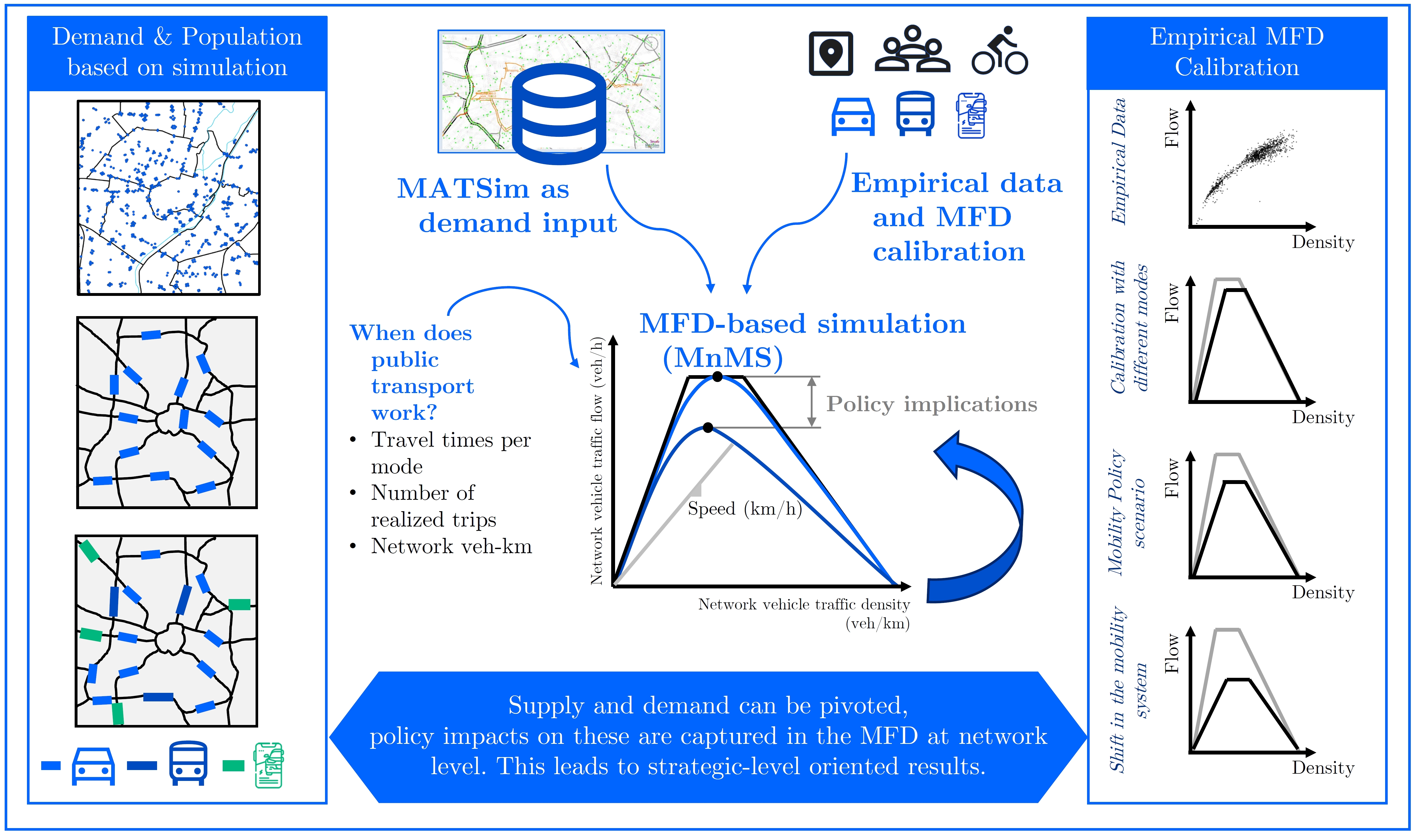
Project C5 will shift the multimodal Macroscopic Fundamental Diagram (MFD) towards standardized applications in transportation planning. We will develop novel assessment indicators and related estimation methods based on the multimodal MFD. We will further develop a simulation environment that allows to explore a vast scenario space at low computational costs. We will also develop a method to calibrate MFD-based assignment models with the outcomes of the AgiMo digital twin. All methods will be directly tested in the study region Munich.
PI: Prof. Allister Loder Team members: Yerko David Calquin
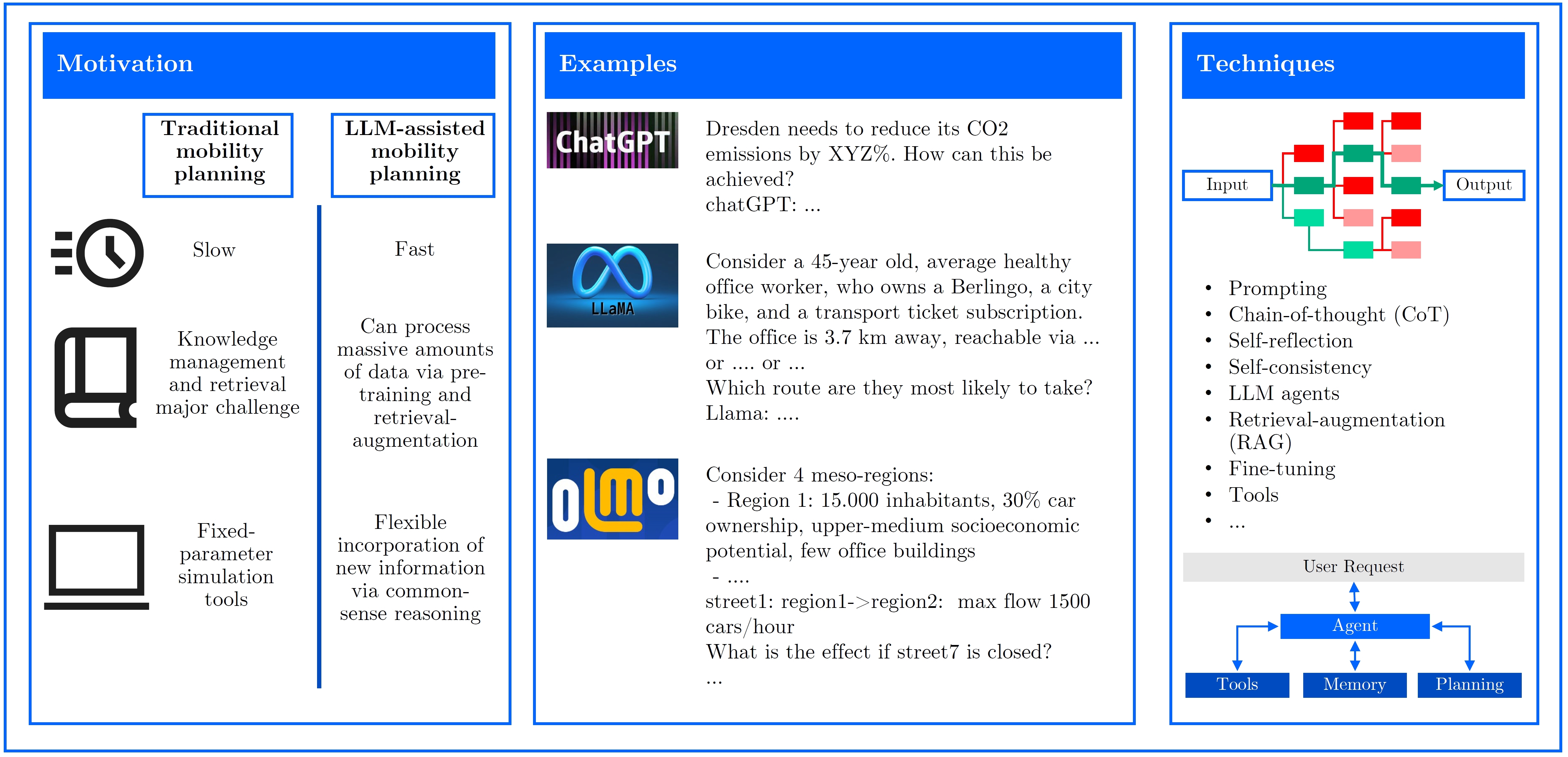
Exploring the potential of LLM-supported mobility planning
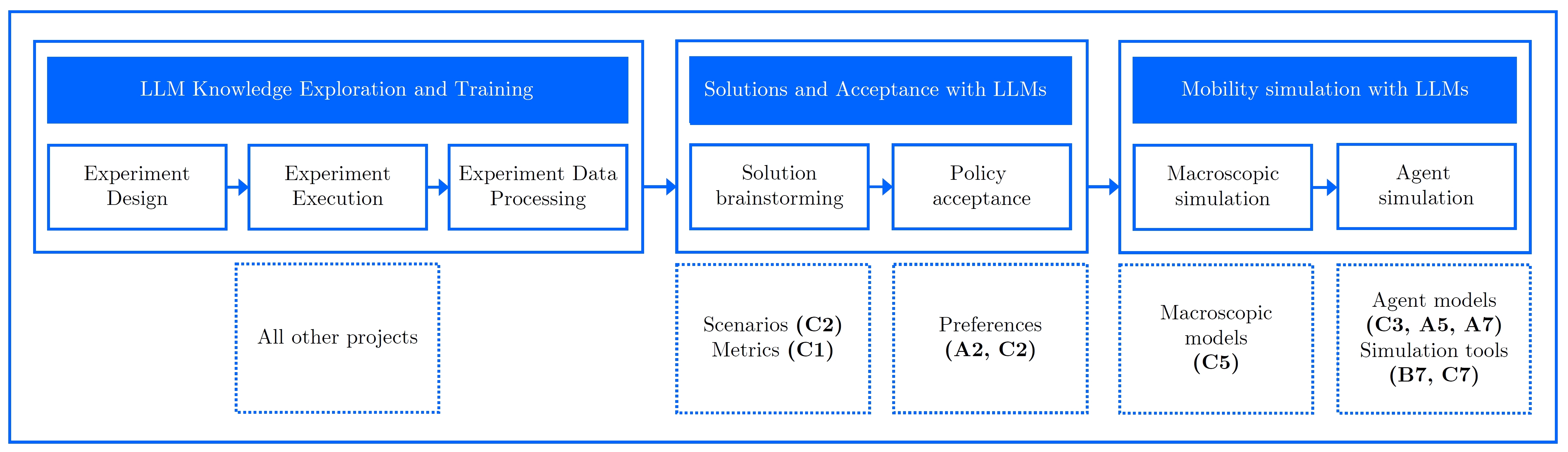
Project C6 will explore the potential of Large Language Models (LLMs) in enhancing simulation-based mobility planning. We will investigate the mobility knowledge already present in current LLMs and build a benchmark to measure it on different mobility tasks, such as geographical and topological facts, individual travel decisions, and the effects of policy measures. We will also evaluate the suitability of LLMs for the input and output of the mobility planning pipeline, i.e., how to brainstorm potential solutions and how to estimate the acceptance of mobility interventions. Finally, we will apply LLMs to (approximate) system-wide simulations to test whether and how they can augment the existing MATSim simulation tool.
PI: Prof. Simon Razniewski Team members: Elza Shakirova
C6
Project figure C6-1; Own illustration; Google Material Symbols, licensed under the Apache License, Version 2.0
Project figure C6-2;Own illustration; Google Material Symbols, licensed under the Apache License, Version 2.0
C7
Data-flexible calibration of large-scale transportation simulation models
Project C7 will develop an automated calibration framework for the heterogeneous microscopic transportation demand models used within this CRC, with the core objectives of (i) framework generalizability, (ii) uncertainty quantification and (iii) automating heuristics for calibration. The framework will involve a modular design of the calibration pipeline to allow for flexible integration with varying components for different uses such as diverse (i) data sources, (ii) optimization algorithms, and (iii) performance measures. We will provide the tools for the calibration of the AgiMo digital twin. The developed techniques will be also applicable to other models.
PI: Prof. Constantinos Antoniou Team members: Barun Das